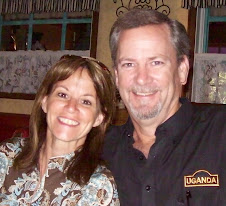
This does not come as a revelation to anyone who even sort of knows me.
Not this kind of chicken...

I watched the neighbor fatten this guy up for a few days before he mysteriously disappeared. I knew what was going to happen. I even tried to talk Mike into a late night rescue of the poor guy. But alas, he became Christmas dinner. I've stopped giving names to the chickens, cows, goats and roosters that hang out by our kitchen window. They will be someone's meal.
The kind of chicken I'm referring to is the new reputation I have in a fishing village across Lake Victoria that Mike and I visited earlier this week.
The fishing village is maybe 30 kilometers from Kampala.
By boat.
Have you seen the boats here? Well, truthfully I hadn't either, but that makes no difference. I've seen how other things are built and maintained.
And if the boats are ok, why did our host give us an option...by land or by sea?
I chose by road. I may have chosen wrong. I don't know how many kilometers it is by land; it can't be that many. By boat the trip was 15 minutes.
The journey began perfectly. It was a beautiful day, pretty much like all the days here. Many of the cities folks were still out in the villages visiting family for Christmas, so traffic jams were not a problem. The road was nicely paved and a pleasure to drive on. Mostly.
Just as we were moving along at a pretty good clip, Godfrey, our host let us know that we were about to turn on a road that was not “as nice.”

About 50 kilometres out of town, the pavement was turned off like a tap. We had turned onto a horribly washed-out dirt road.
You have to envision this…deep mud ruts ground into the red clay, loose stones that make you slide, boulders blocking clear areas that weren’t axel deep holes, parts washed out so much we weren’t sure if we were still on the road or a path through the jungle; twisting turns around hills on a path barely wide enough for one vehicle. We’ve been on some bad roads here, but this was so bad that no amount of skill, no weaving, no speed variation could dampen the blows.
The Big Horn was traveling in a controlled fall bouncing from spot to spot.
 Bouncing up and down for over two hours of our trip kept us praying for a decent bathroom and soon. Though by the looks of our surroundings, it wasn’t promising.
After three and a half hours of spine wrenching insanity, we had arrived.
The fishing village is maybe 30 kilometers from Kampala.
By boat.
Have you seen the boats here? Well, truthfully I hadn't either, but that makes no difference. I've seen how other things are built and maintained.
And if the boats are ok, why did our host give us an option...by land or by sea?
I chose by road. I may have chosen wrong. I don't know how many kilometers it is by land; it can't be that many. By boat the trip was 15 minutes.
The journey began perfectly. It was a beautiful day, pretty much like all the days here. Many of the cities folks were still out in the villages visiting family for Christmas, so traffic jams were not a problem. The road was nicely paved and a pleasure to drive on. Mostly.
Just as we were moving along at a pretty good clip, Godfrey, our host let us know that we were about to turn on a road that was not “as nice.”

About 50 kilometres out of town, the pavement was turned off like a tap. We had turned onto a horribly washed-out dirt road.
You have to envision this…deep mud ruts ground into the red clay, loose stones that make you slide, boulders blocking clear areas that weren’t axel deep holes, parts washed out so much we weren’t sure if we were still on the road or a path through the jungle; twisting turns around hills on a path barely wide enough for one vehicle. We’ve been on some bad roads here, but this was so bad that no amount of skill, no weaving, no speed variation could dampen the blows.
The Big Horn was traveling in a controlled fall bouncing from spot to spot.
 Bouncing up and down for over two hours of our trip kept us praying for a decent bathroom and soon. Though by the looks of our surroundings, it wasn’t promising.
After three and a half hours of spine wrenching insanity, we had arrived.
The Orphanage we pulled up to was like an oasis in the desert. Neatly built houses, grass covering the front yards…and there…gleaming in the sun, pit-latrines. The one they unlocked for us must have been a special “guest” bathroom as the others weren’t locked.
I don’t really want to imagine the others.
Immediately, those in charge of the orphanage we’d come to meet with began inquiring as to the method we traveled. Seems coming by land is simply unheard of. To avoid too many explanations, I simply answered, “I’m not very comfortable on the water.” (not a stretch, by the way)
 By the time the director of the camp found us, a highly-educated, well spoken native Ugandan moving around the hills and rocks of the camp via wheel chair, my ‘fear’ had preceded me. He very seriously focused on Mike and asked, “Do you have a pool at home?” Mike replied, “In Florida we did.” “Well then, you must immediately cover it, for your wife is not comfortable on water.” I didn’t know what to make of his comments as this was the first time we had encountered a Ugandan with an American sense of humour.
December and January in Uganda is like the American’s “summer vacation.” So while on a break from school, this village was hosting a ‘summer camp.’ Some 5000 children are sponsored into one camp per year. They’re doing awesome work in this village. This particular day, a pastor was very boldly delivering a message on premarital sex, STD’s and HIV/AIDS. His candidness was even making me blush.
This village is run by a church just across the lake (had I opted to go via boat, I would have seen the church I was told…a few times), and sponsored by donors in Texas and California. The neatly built concrete and brick homes sat on tidy grounds, and inside were 3 bedrooms, a living room and an eating area. The homes hold 16 children and a house mama. The bunk beds were stacked three high.
The children currently living here are from 6 to 19 years of age; orphans, or children who do not have families able to care for them. Children that weren’t part of the camp this day were busy washing their clothes in wash tubs and hanging them to dry or preparing the mid-day meal in the kitchen houses (separate buildings to keep the smoke out of the main homes.) They were neatly dressed, clean, busy, and had clearly been around white people enough that few spent much time gawking at us.
Here, there is an agricultural program in full swing, a medical clinic (with doors and windows, equipment and a real nurse), family garden plots where much of the families meals come from, schools, boreholes, a method for safe water, a generator which keeps some lights on and refrigeration of some foods.
Awesome. What were we doing here?

Before joining our host and his wife (both teachers at this school) for lunch in their sweet, humble home, about the size of one of your closets (and they care for three family members, have one baby and one on the way), Godfrey wanted to take us to visit the fishing village. We were feeling pretty good about this place! Lead on!
This time he gave me the choice of walking or driving. Which is funny only because there is NO way to get a vehicle through this area and down to the fishing village.
After about 10 minutes into our walk, we saw children running towards us…lots of children yelling “mzungus.” The children in Uganda always put a smile on our faces. They are beautiful, curious, and loveable. Except those that have never seen a white person. That happened on our drive in. A young girl about 10 got a glimpse of our white faces and with a horrified expression on her face, grabbed her baby sister and ran!
We were immediately guests of honour. Africa is like that. We arrive and instantly, betrayed by the color of our skin, are assumed to be members of the super-rich. It’s difficult to adjust to being a spectacle. White people here are loved as givers of gifts, misled by scammers, reviled for a history we didn’t condone, envied by the disenchanted motivated.
You must be careful to not develop an unintentional haughtiness because without question you are more knowledgeable and richer. That jab of uneasiness we feel is comforting, reminding us that this is unearned respect…not automatically due. It keeps us humble.
As we began walking through the village, time seemed to slip out of gear. Everything was happening in slow motion.
The children had grabbed hold of Mike and I. Two little girls had a death grip on each of my hands, and they weren’t letting go. They tried to shoo the other little girls away, but they weren’t easily dissuaded. The same was happening to Mike with the little boys of the village.
 They all just wanted to put a hand on us. Just touch us. As I stood numbly, and helplessly staring at a young woman with scabbed over cuts and blue and purple swelled bruises all over her face, I felt one of the girls rubbing my arm; one putting her little hand up my sleeve. They wanted to touch our skin.
The pastor was speaking to the woman in a language we weren’t familiar with. She sat stoically, answering his questions, while keeping a suspicious eye on us.
The huts were partially washed away, some completely gone. The floors covered in cow dung, mixing with the odors of raw sewage, trash and dead fish was almost more than we could bear as we walked through.
These children had everything. That is if you count lice, ringworm, hookworm, scabies and malnutrition. I can’t deny that for a few minutes my mind was trying to think of ways to protect my skin and hair from the things oozing out of their skin and heads. As they desperately tried to communicate in their language, or with their eyes, or smiles, or curious expressions, you can’t help but fall in love with them.
The little girl who had grabbed my left hand apparently needed to run and fetch something. She and the little girl on my right had a brief conversation as she was moving my left hand into the other little girls hand. The pastor laughed and shared with me that she was getting her friend to “save her place” with my hand…not to let anyone else get my hand until she returned.
We could barely walk with the number of kids clinging on to us. Suddenly a wildly excited man came running over yelling something to the people and the pastor in a still unidentified language. The pastor talked with him for a moment before the young man moved away. He explained to us that the man was high on opium. Something available in the village. Home grown. He had cut off three fingers of his left hand, “just because he could.” Possibly the happiest man in the village.
He freaked me out a little when he came back up to me, grabbing my hands and shrieking something. The children all laughed. He seems to have made a joke. I was glad I didn’t understand. He was covered with sores and his eyes were yellow, red and glassy.
There is no school here. A couple of the fortunate ones are sponsored by the village down the hill to attend school; sometimes their mothers let them go. None of the children speak English. They don’t have medical clinics, beds, mosquito nets, medicine, soap, water, or enough food. They don’t know how to farm. It’s a fishing village.
The men beat the women, and the village people mind their own business. The men leave for months at a time to fish different waters, leaving the women and children to fend for themselves.
HIV/AIDS is rampant, as is every other illness and disease you can imagine.
The pastor grabs a few shillings from our host and buys some fish from one of the fishermen. The eyes of the dead fish blankly staring are remarkably like the eyes of most of the adults in the village.
It’s hard to talk the children into releasing our hands and head back down the path to their homes as we start traveling the opposite direction. Just 10 minutes from hope. 10 minutes from civilization. 10 minutes from the 21st century.
We spent the rest of the evening trying not to think about them. But every night they’re in my dreams. I move between despair and seething at their condition. At the lac k of assistance; the lack of care; the lack of opportunity.
We’ll visit them again soon. Probably by boat.
I don’t really want to imagine the others.
Immediately, those in charge of the orphanage we’d come to meet with began inquiring as to the method we traveled. Seems coming by land is simply unheard of. To avoid too many explanations, I simply answered, “I’m not very comfortable on the water.” (not a stretch, by the way)
 By the time the director of the camp found us, a highly-educated, well spoken native Ugandan moving around the hills and rocks of the camp via wheel chair, my ‘fear’ had preceded me. He very seriously focused on Mike and asked, “Do you have a pool at home?” Mike replied, “In Florida we did.” “Well then, you must immediately cover it, for your wife is not comfortable on water.” I didn’t know what to make of his comments as this was the first time we had encountered a Ugandan with an American sense of humour.
December and January in Uganda is like the American’s “summer vacation.” So while on a break from school, this village was hosting a ‘summer camp.’ Some 5000 children are sponsored into one camp per year. They’re doing awesome work in this village. This particular day, a pastor was very boldly delivering a message on premarital sex, STD’s and HIV/AIDS. His candidness was even making me blush.
This village is run by a church just across the lake (had I opted to go via boat, I would have seen the church I was told…a few times), and sponsored by donors in Texas and California. The neatly built concrete and brick homes sat on tidy grounds, and inside were 3 bedrooms, a living room and an eating area. The homes hold 16 children and a house mama. The bunk beds were stacked three high.
The children currently living here are from 6 to 19 years of age; orphans, or children who do not have families able to care for them. Children that weren’t part of the camp this day were busy washing their clothes in wash tubs and hanging them to dry or preparing the mid-day meal in the kitchen houses (separate buildings to keep the smoke out of the main homes.) They were neatly dressed, clean, busy, and had clearly been around white people enough that few spent much time gawking at us.
Here, there is an agricultural program in full swing, a medical clinic (with doors and windows, equipment and a real nurse), family garden plots where much of the families meals come from, schools, boreholes, a method for safe water, a generator which keeps some lights on and refrigeration of some foods.
Awesome. What were we doing here?

Before joining our host and his wife (both teachers at this school) for lunch in their sweet, humble home, about the size of one of your closets (and they care for three family members, have one baby and one on the way), Godfrey wanted to take us to visit the fishing village. We were feeling pretty good about this place! Lead on!
This time he gave me the choice of walking or driving. Which is funny only because there is NO way to get a vehicle through this area and down to the fishing village.
After about 10 minutes into our walk, we saw children running towards us…lots of children yelling “mzungus.” The children in Uganda always put a smile on our faces. They are beautiful, curious, and loveable. Except those that have never seen a white person. That happened on our drive in. A young girl about 10 got a glimpse of our white faces and with a horrified expression on her face, grabbed her baby sister and ran!
We were immediately guests of honour. Africa is like that. We arrive and instantly, betrayed by the color of our skin, are assumed to be members of the super-rich. It’s difficult to adjust to being a spectacle. White people here are loved as givers of gifts, misled by scammers, reviled for a history we didn’t condone, envied by the disenchanted motivated.
You must be careful to not develop an unintentional haughtiness because without question you are more knowledgeable and richer. That jab of uneasiness we feel is comforting, reminding us that this is unearned respect…not automatically due. It keeps us humble.
As we began walking through the village, time seemed to slip out of gear. Everything was happening in slow motion.
The children had grabbed hold of Mike and I. Two little girls had a death grip on each of my hands, and they weren’t letting go. They tried to shoo the other little girls away, but they weren’t easily dissuaded. The same was happening to Mike with the little boys of the village.
 They all just wanted to put a hand on us. Just touch us. As I stood numbly, and helplessly staring at a young woman with scabbed over cuts and blue and purple swelled bruises all over her face, I felt one of the girls rubbing my arm; one putting her little hand up my sleeve. They wanted to touch our skin.
The pastor was speaking to the woman in a language we weren’t familiar with. She sat stoically, answering his questions, while keeping a suspicious eye on us.
The huts were partially washed away, some completely gone. The floors covered in cow dung, mixing with the odors of raw sewage, trash and dead fish was almost more than we could bear as we walked through.
These children had everything. That is if you count lice, ringworm, hookworm, scabies and malnutrition. I can’t deny that for a few minutes my mind was trying to think of ways to protect my skin and hair from the things oozing out of their skin and heads. As they desperately tried to communicate in their language, or with their eyes, or smiles, or curious expressions, you can’t help but fall in love with them.
The little girl who had grabbed my left hand apparently needed to run and fetch something. She and the little girl on my right had a brief conversation as she was moving my left hand into the other little girls hand. The pastor laughed and shared with me that she was getting her friend to “save her place” with my hand…not to let anyone else get my hand until she returned.
We could barely walk with the number of kids clinging on to us. Suddenly a wildly excited man came running over yelling something to the people and the pastor in a still unidentified language. The pastor talked with him for a moment before the young man moved away. He explained to us that the man was high on opium. Something available in the village. Home grown. He had cut off three fingers of his left hand, “just because he could.” Possibly the happiest man in the village.
He freaked me out a little when he came back up to me, grabbing my hands and shrieking something. The children all laughed. He seems to have made a joke. I was glad I didn’t understand. He was covered with sores and his eyes were yellow, red and glassy.
There is no school here. A couple of the fortunate ones are sponsored by the village down the hill to attend school; sometimes their mothers let them go. None of the children speak English. They don’t have medical clinics, beds, mosquito nets, medicine, soap, water, or enough food. They don’t know how to farm. It’s a fishing village.
The men beat the women, and the village people mind their own business. The men leave for months at a time to fish different waters, leaving the women and children to fend for themselves.
HIV/AIDS is rampant, as is every other illness and disease you can imagine.
The pastor grabs a few shillings from our host and buys some fish from one of the fishermen. The eyes of the dead fish blankly staring are remarkably like the eyes of most of the adults in the village.
It’s hard to talk the children into releasing our hands and head back down the path to their homes as we start traveling the opposite direction. Just 10 minutes from hope. 10 minutes from civilization. 10 minutes from the 21st century.
We spent the rest of the evening trying not to think about them. But every night they’re in my dreams. I move between despair and seething at their condition. At the lac
 k of assistance; the lack of care; the lack of opportunity.
We’ll visit them again soon. Probably by boat.